What would it actually be like to walk through an English town in the fourteenth century?
Historical books often tell us about kings, battles, political conflicts, famous writers, and major events. Those subjects are important, but they do not always answer the everyday questions that make the past feel understandable.
What would people eat? How would they travel? What would a typical street smell like? Where would an ordinary traveler sleep? What happened in a medieval marketplace? How did people understand illness, religion, work, money, clothing, crime, and social status?
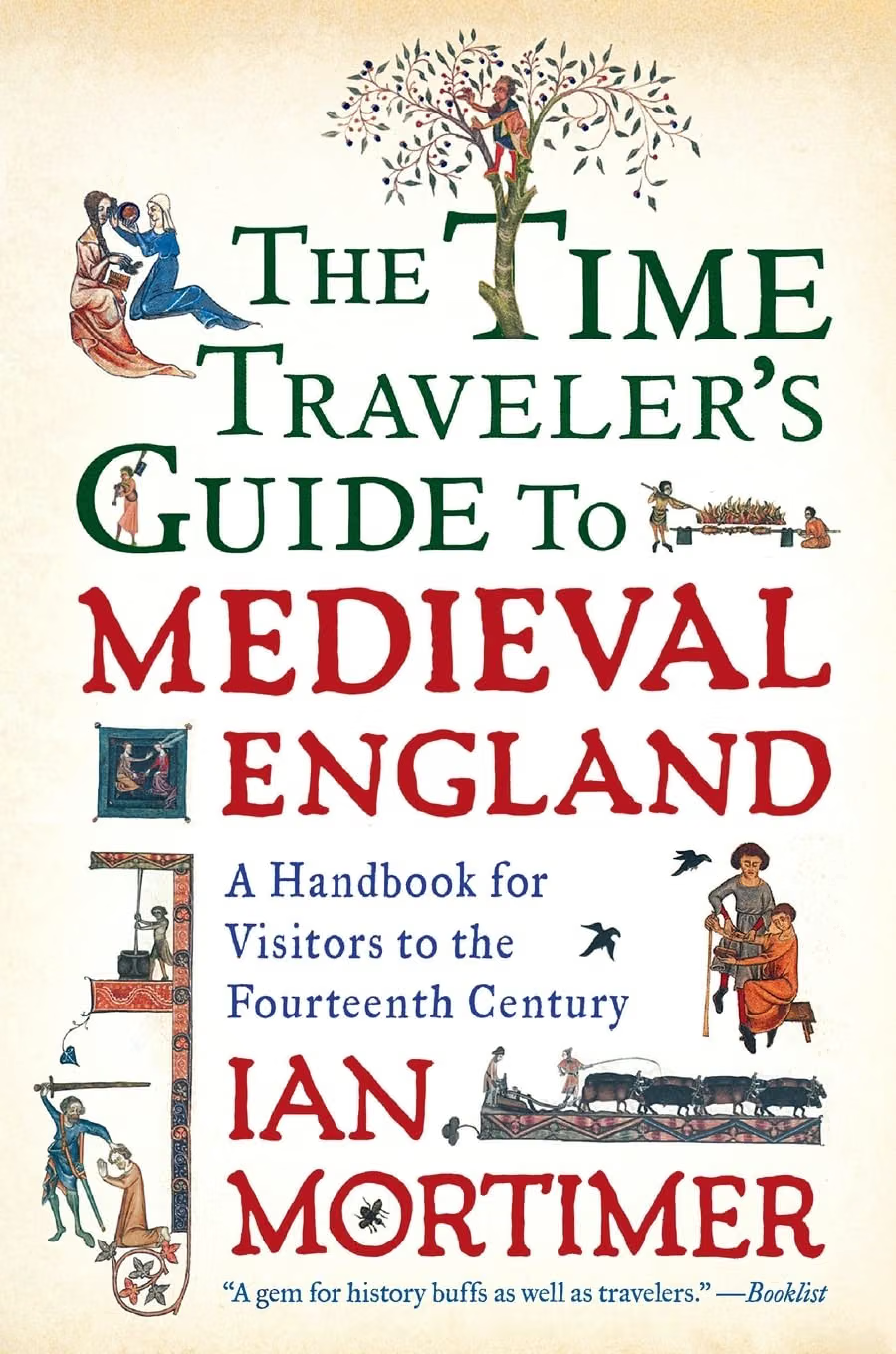
The Time Traveler’s Guide to Medieval England: A Handbook for Visitors to the Fourteenth Century approaches medieval history from a different direction. Written by historian Ian Mortimer, the book presents fourteenth-century England through the perspective of an imagined visitor arriving in the period.
Instead of treating medieval England as a collection of dates and famous names, the book explores the environment in which people actually lived.
That approach makes the fourteenth century easier to visualize. Readers are encouraged to think about the practical realities of medieval life, including housing, food, clothing, travel, hygiene, occupations, social structures, religion, health, law, and entertainment.
The result is a historical guide that can be approached both as an introduction to medieval England and as a way of putting familiar historical events into their everyday context.
Understanding Fourteenth-Century England
The fourteenth century was a period of significant change in England.
It included the reigns of Edward II, Edward III, and Richard II. It was also a period marked by military conflict, economic pressures, political tensions, religious life, technological developments, and severe demographic disruption.
One of the most significant events was the arrival of the Black Death in the middle of the century.
But understanding the period only through these major events can leave out much of what made medieval society function.
People still had to work, eat, travel, trade, raise children, attend religious services, settle disputes, find accommodation, maintain homes, and participate in local communities.
Mortimer’s approach gives attention to these ordinary experiences.
Rather than imagining medieval England as a distant world populated exclusively by monarchs and knights, readers encounter a society made up of people from many different occupations and social backgrounds.
Key Features of The Time Traveler’s Guide to Medieval England
A Visitor’s Perspective
The central concept is simple: imagine that you are a visitor arriving in fourteenth-century England.
This perspective changes the questions a reader naturally asks.
Instead of simply asking when a particular event happened, you might ask what you would see when entering a town.
Instead of learning that medieval people wore particular types of clothing, you can consider what different garments communicated about occupation, wealth, status, and practicality.
Instead of reading that transportation was slower, you can consider what traveling between communities actually involved.
This visitor-oriented structure gives historical information an everyday context.
Everyday Life
One of the book’s major strengths as a historical subject is its attention to ordinary life.
Medieval England was not simply a world of castles and royal courts.
Most people lived within communities shaped by agriculture, crafts, commerce, religion, family relationships, local government, and social hierarchy.
The book explores many of these aspects and helps readers understand how they fit together.
This makes it particularly useful for readers who enjoy social history.
Towns and Villages
The experience of medieval life could differ considerably depending on where someone lived.
A village based around agriculture had different characteristics from a busy commercial town.
Towns brought together merchants, craftspeople, laborers, travelers, religious institutions, markets, and administrative functions.
Markets were particularly important.
They provided places where people could buy and sell goods while also creating opportunities for news, social interaction, and the exchange of information.
A medieval town was therefore more than a collection of buildings.
It was a network of economic and social relationships.
Food and Drink
Food is one of the easiest ways to connect with the past because eating is a universal human experience.
The medieval diet varied according to social position, location, season, occupation, and wealth.
Different people had access to different foods, and what was available could depend heavily on local production and trade.
Bread and ale played important roles in many people’s diets, while meat, fish, dairy products, vegetables, grains, and other foods appeared in different combinations.
The important point is that there was no single “medieval diet.”
A wealthy household and a poor rural laborer did not experience food in the same way.
Understanding these differences helps prevent the common mistake of treating medieval society as culturally uniform.
Clothing and Appearance
Clothing was practical, but it also communicated information.
A person’s garments could reveal something about occupation, wealth, social position, and local customs.
Materials and construction methods influenced what people could wear.
For an imagined time traveler, clothing would therefore be one of the first noticeable differences.
Modern visitors are accustomed to a wide variety of styles and relatively inexpensive manufactured clothing.
Fourteenth-century clothing existed within a very different economic system.
Textiles required labor, materials, and skilled production, and garments could represent a meaningful investment.
Understanding clothing in this context helps explain why regulations and social expectations surrounding dress could matter.
Travel in Medieval England
Modern transportation makes distances feel smaller.
A journey that takes a few hours by car today could have required much more time in medieval England.
Travel might involve walking, horses, carts, boats, or combinations of different methods.
Road conditions could vary, weather could influence travel, and accommodation was an important consideration.
A traveler also had to think about food, safety, money, directions, and where to spend the night.
This practical reality is one reason the “visitor” concept works so well.
It encourages readers to consider historical geography as something experienced physically rather than merely viewed on a map.
A medieval journey was not simply a line between two locations.
It was a sequence of places, people, obstacles, and decisions.
Medieval Accommodation
A visitor arriving in a medieval community would need somewhere to stay.
Accommodation could vary according to location and social status.
Religious institutions, private households, inns, and other forms of hospitality could all play roles in supporting travelers.
The concept of hospitality itself had social and economic dimensions.
Travelers needed food and shelter, while communities had systems for managing visitors.
For a modern reader, this provides an interesting comparison with contemporary travel.
Today, travelers can use digital maps, online booking systems, reviews, and instant communication.
A fourteenth-century traveler depended much more heavily on local knowledge and physical infrastructure.
Work and Occupations
Medieval England contained a wide range of occupations.
Agriculture was fundamental to the economy, but towns supported many crafts and commercial activities.
People worked as farmers, laborers, merchants, artisans, servants, clergy, administrators, builders, tradespeople, and professionals.
Guilds and occupational communities could play important roles in urban economic life.
The nature of work also depended on social status and location.
A person born into a particular family might have very different opportunities from someone belonging to another social group.
Understanding employment therefore requires looking at the wider structure of medieval society.
Social Hierarchy
Medieval English society was strongly hierarchical.
Kings and nobles occupied positions of considerable political and economic power, while knights, clergy, merchants, craftspeople, agricultural workers, servants, and others occupied different positions within the social order.
This hierarchy affected many aspects of life.
It influenced relationships, obligations, opportunities, legal circumstances, housing, clothing, and access to resources.
However, hierarchy should not be confused with complete immobility.
Medieval society was complex, and wealth, occupation, marriage, inheritance, education, religious institutions, and urban commerce could influence an individual’s circumstances.
The book’s everyday perspective allows readers to see social hierarchy as something experienced through ordinary interactions rather than as an abstract diagram.
Religion and Medieval Life
Religion was deeply embedded in medieval English society.
The Christian church influenced the calendar, community life, education, charitable activities, ceremonies, architecture, and people’s understanding of the world.
Religious observance was not confined to church buildings.
It could influence work patterns, holidays, festivals, family events, death rituals, and everyday attitudes.
For modern readers living in societies where religion may play a different role in public life, understanding this context is important.
Without it, many aspects of medieval culture can appear confusing or disconnected.
Religious institutions were also significant economic and political organizations.
Monasteries, churches, and other religious communities owned land, employed people, provided services, and participated in wider society.
Health and Medicine
Medical knowledge in the fourteenth century was very different from modern medicine.
People understood illness through frameworks that included ideas about bodily balance, environment, diet, and other causes.
Medical practitioners existed, but access to medical care varied considerably.
Ordinary people also relied on household knowledge, traditional practices, religious beliefs, and local remedies.
The arrival of the Black Death exposed the limitations of medieval medical understanding.
The plague devastated communities across Europe and England and transformed the country’s demographic, economic, and social circumstances.
For a reader approaching the period through everyday life, the plague becomes more than a date in a textbook.
It becomes an event that affected families, workplaces, communities, labor markets, religious practices, and people’s understanding of mortality.
The Black Death and Its Impact
The Black Death reached England in 1348–1349 and caused enormous loss of life.
The exact scale of mortality is difficult to establish, and estimates vary among historians, but its effects were profound.
Entire communities were affected.
The loss of population changed relationships between labor and land, influenced wages and employment, altered patterns of settlement, and affected religious and social institutions.
The event also demonstrates why demographic history matters.
When a large proportion of a population disappears within a relatively short period, everyday systems cannot remain unchanged.
Agricultural production, inheritance, labor availability, trade, and family structures all experience consequences.
A book focused on everyday medieval life can therefore help readers understand the Black Death not simply as an epidemic but as a major transformation of society.
Crime and Law
Medieval communities had systems of law enforcement and justice, although these operated very differently from modern legal institutions.
Local courts, officials, community responsibilities, and royal authority all played roles.
Crime could include theft, violence, property disputes, fraud, and other offenses.
The experience of justice could depend on social position and local circumstances.
For a time traveler, understanding the legal environment would be important.
Modern assumptions about police, courts, documentation, and individual rights cannot simply be projected backward onto fourteenth-century society.
Historical context matters.
Entertainment and Leisure
Medieval people did not spend all their time working.
Entertainment included festivals, games, storytelling, music, dancing, religious celebrations, public events, and other forms of recreation.
Different social groups had access to different activities.
Some entertainment was communal and connected to the religious or agricultural calendar.
Others were associated with particular occupations or social groups.
The existence of leisure is a useful reminder that historical people had emotional and social lives that extended beyond survival.
They celebrated, joked, competed, socialized, watched performances, and told stories.
How the Book Can Be Used
As an Introduction to Medieval History
Readers unfamiliar with medieval England can use the book as an entry point into the period.
Its everyday-life approach provides a foundation before moving into more specialized historical subjects.
After reading about medieval towns, for example, a reader might become interested in medieval commerce.
Someone fascinated by the Black Death might move on to demographic history.
Another reader might explore medieval religion, warfare, architecture, or literature.
As a Companion to Historical Fiction
Readers of historical novels often want to understand how accurately fictional stories represent their setting.
A historical guide can provide useful context for interpreting fiction.
When reading a novel set in fourteenth-century England, readers can pay attention to clothing, food, travel, occupations, social relationships, religious practices, and language.
The book can therefore function as background reading alongside historical fiction.
For Students
Students studying medieval history may find an everyday-life perspective useful when preparing essays, presentations, or research projects.
Instead of focusing exclusively on major political events, students can consider how historical developments affected ordinary people.
This can provide additional context for understanding broader themes such as economic change, social hierarchy, urbanization, religion, and demographic crisis.
For Travelers Interested in History
People visiting England’s medieval sites may also find this type of historical background useful.
Historic castles, churches, cathedrals, city centers, walls, bridges, and archaeological sites can be easier to understand when visitors have a sense of the society that created them.
A building becomes more meaningful when you understand who used it and why.
Who May Find This Book Suitable?
Readers Interested in Medieval England
The obvious audience is anyone curious about fourteenth-century English society.
The book offers a way to approach the period through ordinary experiences rather than focusing exclusively on political history.
History Beginners
People who find conventional history books difficult to approach may appreciate a format centered on practical questions.
Instead of memorizing long lists of dates and names, readers can begin with subjects such as food, clothing, housing, travel, and work.
These familiar subjects provide an accessible route into historical study.
Students of History
Students can use the book as supplementary reading when studying medieval England.
It can help provide social context around events and institutions that may otherwise seem disconnected.
Historical Fiction Readers
Readers who enjoy medieval fiction can use the book to build a more informed mental picture of the period.
It can also encourage readers to distinguish between historically documented practices and fictional storytelling.
Genealogy and Local History Enthusiasts
People researching family history may also find the social background useful.
Understanding how occupations, communities, landholding, religion, and social structures operated can help provide context for historical records.
Of course, a general history book cannot establish the circumstances of a specific ancestor. Primary documents and specialized local sources remain necessary for genealogical conclusions.
Important Things to Consider
This Is a Historical Interpretation
No single book can reproduce the complete experience of medieval England.
Historical writing depends on surviving evidence, interpretation, comparison of sources, and scholarly debate.
Readers should therefore distinguish between documented evidence and an author’s reconstruction or interpretation.
Medieval England Was Not Uniform
The experience of a wealthy landowner differed from that of a rural laborer.
Life in London differed from life in a small village.
A merchant’s daily routine differed from that of a monk, sailor, craftsman, or agricultural worker.
Age, gender, occupation, wealth, location, and social position all mattered.
Readers should avoid treating the book’s descriptions as though every person in fourteenth-century England experienced life in exactly the same way.
Modern Terms Can Be Misleading
Some modern concepts do not have direct equivalents in medieval society.
Words such as “government,” “economy,” “class,” “career,” or “healthcare” can be useful for explanation, but their medieval realities were not identical to modern institutions.
Historical interpretation requires understanding concepts within their original context.
Historical Evidence Has Limits
Much of what historians know about medieval life comes from surviving documents, archaeological evidence, architecture, artwork, literary works, administrative records, and other sources.
But survival of evidence is uneven.
Some groups left more records than others.
A wealthy household might appear in surviving documentation in ways that an ordinary laborer’s family does not.
This creates limitations that readers should keep in mind.
Comparison of General Historical Guide Categories
Different history books serve different purposes.
| Category | Main Focus | Typical Use |
|---|---|---|
| Political history | Kings, governments, wars, institutions | Understanding political developments |
| Military history | Armies, battles, strategy and weapons | Studying warfare |
| Social history | Everyday life and social relationships | Understanding how people lived |
| Economic history | Trade, labor, land and production | Understanding economic systems |
| Biography | Individual historical figures | Exploring a particular person’s life |
| Historical travel guide | Places and historical context | Understanding locations and heritage |
| Everyday-life history | Food, clothing, work, travel and customs | Visualizing ordinary experiences |
The Time Traveler’s Guide to Medieval England belongs primarily to the social and everyday-life side of historical writing.
That does not make political or military history less important. Instead, it provides another perspective.
Knowing that a king went to war tells us something about political history.
Understanding how that war affected taxation, labor, travel, food prices, families, and communities tells us something about social history.
Both perspectives can contribute to a fuller understanding of the past.
Medieval Cities Through a Modern Lens
One of the most interesting exercises for a modern reader is comparing medieval towns with contemporary cities.
Today, urban residents are accustomed to electric lighting, sanitation systems, motor vehicles, digital communication, supermarkets, refrigeration, modern medicine, and mass-produced goods.
A fourteenth-century town operated under very different conditions.
Waste management, water supply, transportation, construction, food preservation, and communication were shaped by available technologies and local resources.
Streets were shared by pedestrians, animals, carts, and other forms of transportation.
Buildings were constructed from materials and according to techniques that reflected medieval conditions.
The sensory environment would have been very different.
Understanding these differences helps prevent the common tendency to imagine medieval towns as modern cities with older architecture.
They were fundamentally different environments.
Communication Without Modern Technology
Fourteenth-century people lived in a world without telephones, television, radio, or the internet.
Information moved through people and physical networks.
Letters, messengers, travelers, merchants, religious institutions, markets, public announcements, and word of mouth all contributed to communication.
News could travel surprisingly far, but it did not move instantly.
This influenced how communities understood distant events.
A modern person can receive breaking news from another continent within seconds.
A medieval person might learn about distant political or military developments through travelers, official announcements, merchants, or other intermediaries.
The difference changes the relationship between distance and information.
Money and Commerce
Economic activity was central to medieval life.
People bought and sold goods, paid rents and taxes, traded agricultural products, employed workers, and participated in local and regional markets.
Coins existed in different denominations, and financial relationships could be complicated.
Credit, debt, rents, wages, and obligations all formed part of the economic environment.
Understanding commerce also helps explain why towns mattered.
Urban centers could bring together producers, traders, consumers, craftspeople, and visitors.
Markets connected local production with wider economic networks.
Reading Medieval History With Context
One of the most valuable habits for historical readers is avoiding the assumption that modern values, technologies, and institutions existed in earlier periods.
Medieval people made decisions within the knowledge and circumstances available to them.
Their understanding of medicine, religion, government, geography, science, and society developed within a very different intellectual environment.
This does not mean every medieval practice should be viewed uncritically.
It means historical events should first be understood within their own context.
Only then can readers make meaningful comparisons with modern life.
Frequently Asked Questions
Who wrote The Time Traveler’s Guide to Medieval England?
The book was written by historian Ian Mortimer.
What period does the book cover?
The book focuses primarily on fourteenth-century England.
Is this a book about medieval kings and battles?
Those subjects form part of the historical background, but the book’s main emphasis is broader everyday life and the conditions experienced by people living in medieval England.
What makes the time-traveler approach different?
The book uses the idea of a modern visitor arriving in medieval England to organize historical information around practical questions about daily life.
This encourages readers to think about what they would see, experience, eat, wear, and encounter.
Does the book discuss medieval food?
Yes. Food and drink are among the everyday subjects that help explain differences in social position, resources, and lifestyle.
Does it explain medieval clothing?
Clothing is part of the broader discussion of everyday medieval life, including how garments related to social position and practical circumstances.
Does the book cover travel?
Yes. Medieval transportation and travel conditions are relevant to understanding what movement through fourteenth-century England would have been like.
Does it discuss the Black Death?
The Black Death is an important part of fourteenth-century English history and the wider social context of the period.
Is the book suitable for someone new to medieval history?
Its everyday-life perspective can make it an accessible starting point for readers who want to learn about medieval England without beginning with a highly specialized academic study.
Can the book be used for school research?
It can provide useful background information, but students should consult additional scholarly and primary sources for formal research and verify specific claims according to their assignment requirements.
Is the book a travel guide for modern England?
No. The “guide” concept is historical and imaginative. It is intended to help readers understand fourteenth-century England rather than provide modern travel directions.
Can it help when reading historical fiction?
Yes. Historical context can help readers understand the setting of medieval novels and distinguish plausible historical details from fictional elements.
Was medieval England the same everywhere?
No. Experiences differed according to location, wealth, occupation, social status, and many other circumstances.
Did everyone live in castles?
No. Castles were associated with particular political, military, and social functions. Most people in medieval England lived in other types of homes and communities.
Was medieval life always dominated by warfare?
Warfare was important, but everyday life involved many other activities, including farming, commerce, craftsmanship, religious observance, family life, travel, entertainment, and local administration.
Why is everyday life important when studying history?
Major events are experienced by people.
Understanding everyday life helps explain how political, economic, environmental, and demographic changes affected actual communities.
Can the book tell me exactly what one medieval person experienced?
No. A general historical work reconstructs broader patterns rather than documenting the complete life of one individual.
Are all descriptions of medieval life equally certain?
No. Historical evidence varies in quality and availability, and historians sometimes interpret incomplete evidence differently.
Is the book only useful for people interested in England?
Readers interested in European medieval history may also find it useful because England was part of broader economic, religious, political, and cultural networks. However, the book’s primary geographical focus is England.
Conclusion
Fourteenth-century England can seem distant when approached only through dates, monarchs, battles, and political events.
It becomes considerably easier to imagine when viewed through ordinary experiences.
What did people eat? How did they travel? What happened in a market? Where did people live? What did their clothing communicate? How did religion shape the calendar? How did people respond to illness? What happened when someone broke the law? How did news travel from one community to another?
These questions bring historical society closer to everyday human experience.
The Time Traveler’s Guide to Medieval England: A Handbook for Visitors to the Fourteenth Century by Ian Mortimer uses this perspective to explore medieval England as a lived environment. Its visitor-oriented concept provides a framework for considering food, clothing, travel, work, towns, villages, religion, health, social hierarchy, entertainment, law, and the major disruptions that shaped the century.
The approach is particularly useful because it reminds readers that history is not only about famous individuals.
It is also about ordinary people.
Farmers cultivated land. Craftspeople produced goods. Merchants traveled between markets. Families managed households. Religious communities followed established routines. Travelers searched for food and shelter. Workers negotiated changing economic conditions. Communities responded to disease, political developments, and environmental challenges.
The fourteenth century was neither a simple fantasy world of castles and knights nor a modern society with old-fashioned clothing. It was a complex historical environment shaped by technologies, beliefs, institutions, economic relationships, and social structures that developed under very different circumstances.
Approaching that world through everyday life can make the past more understandable and encourage readers to investigate medieval history in greater depth.
For anyone interested in seeing medieval England from the perspective of an imagined visitor rather than simply studying it as a sequence of historical events, this book offers a practical framework for exploring the fourteenth century.
Leave a Reply